
Ever wondered if your cat is eating the right number of calories, or are you just guessing at each meal?
Calories for cats aren’t one-size-fits-all.
Weight, age, activity and spay/neuter status change the target.
This guide lays out clear daily calorie ranges by weight and life stage, walks you through the simple math behind resting and maintenance needs, and gives easy portion steps you can use this week.
Follow these steps and you’ll stop overfeeding, avoid underfeeding, and keep a closer eye on your cat’s weight and energy.
Daily Calorie Targets for Cats Based on Weight and Life Stage
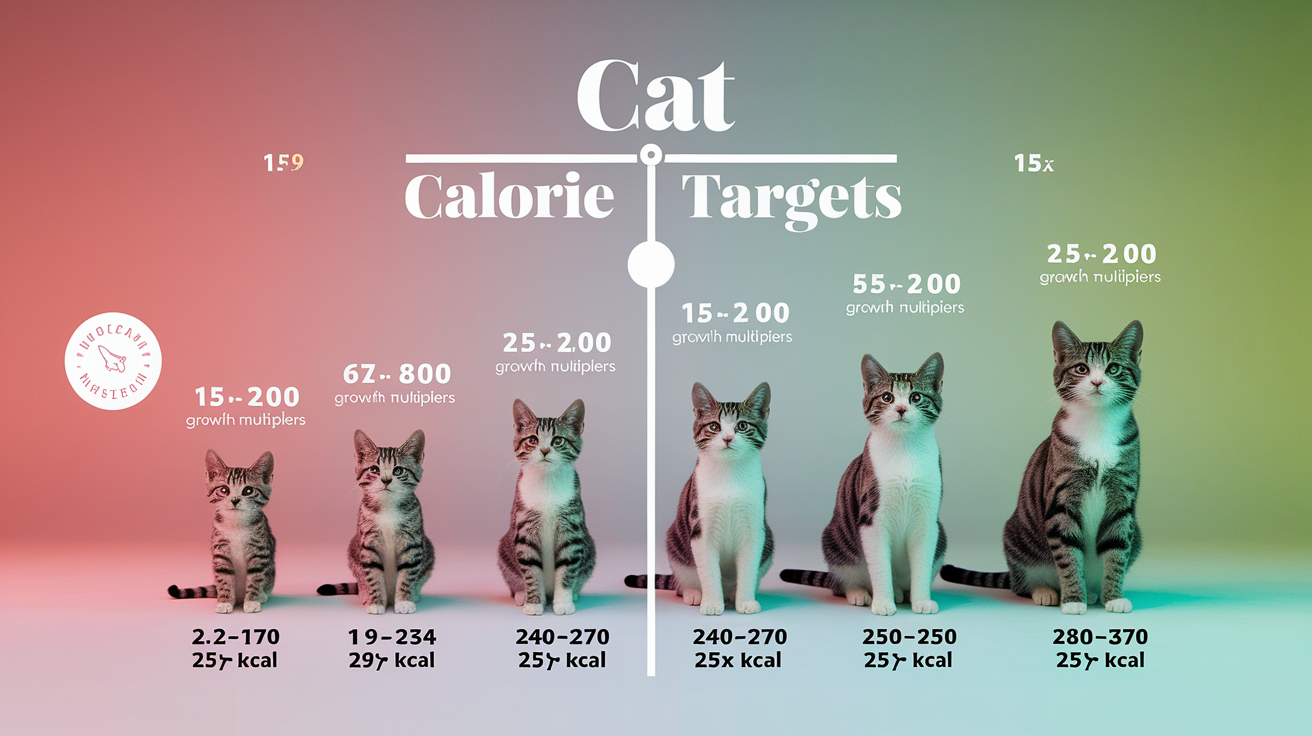
Most adult cats need somewhere between 20 and 33 calories per pound of body weight each day. A typical 10 pound cat usually lands around 200 to 250 calories daily, though some need a bit more or less depending on how active they are and whether they’ve been spayed or neutered. Think of these numbers as starting points. Your cat’s actual needs might fall anywhere within that range.
Weight based calorie ranges give you a clearer picture of what your cat should be eating. A small 5.5 pound cat needs around 180 to 190 calories per day, while a larger 15 pound cat might need anywhere from 280 to 370 calories. These ranges come from WSAVA (World Small Animal Veterinary Association) guidelines and account for typical indoor, moderately active cats.
| Weight (lbs) | Daily Calories (Range) |
|---|---|
| 2.2 | 100–130 kcal |
| 5.5 | 180–190 kcal |
| 9.9 | 240–270 kcal |
| 11 | 250–290 kcal |
| 15.4 | 280–370 kcal |
Kittens are a different story. From birth to four months, they need about 2.5 times their resting energy requirement because they’re growing fast, usually gaining about a pound per month. Between four and twelve months, that multiplier drops to 2 times their resting energy, but they’re still eating considerably more per pound than adult cats. Keep in mind that actual calorie needs can vary by plus or minus 50% from these calculations, so watching your cat’s weight, energy, and body condition matters more than hitting an exact number.
Understanding Cat Calorie Requirements Through RER and MER Formulas
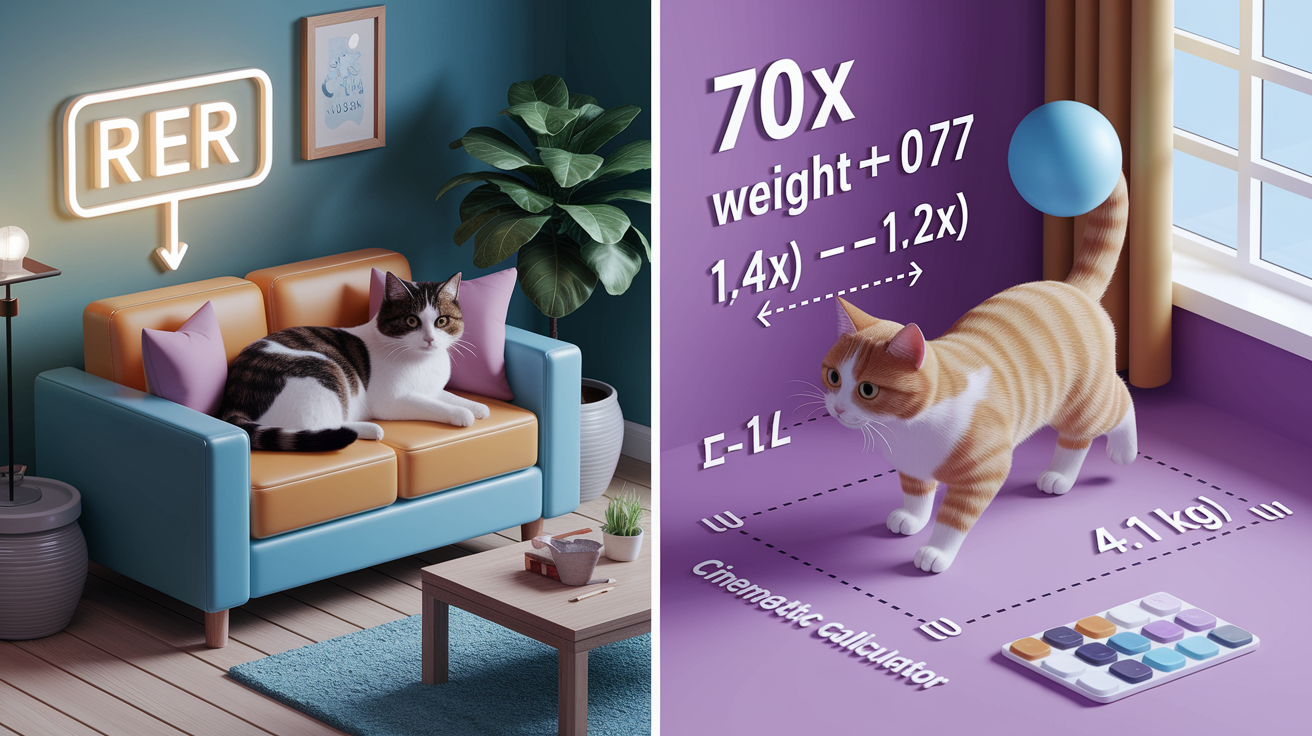
Resting Energy Requirement (RER) is the number of calories your cat would burn just lying around all day doing nothing. It’s the baseline for all other calculations. The formula is 70 multiplied by your cat’s body weight in kilograms raised to the power of 0.67. If math isn’t your thing, don’t worry. Just know that RER gives you the absolute minimum calories needed to keep basic body functions running.
Maintenance Energy Requirement (MER) is what your cat actually needs to live their day to day life, and it’s calculated by multiplying RER by a factor that matches their lifestyle and reproductive status. An intact adult cat needs 1.4 times their RER, while a spayed or neutered cat usually needs 1.2 times RER because their metabolism slows down after the procedure. Cats prone to weight gain might only need 1.0 times RER to avoid packing on extra pounds.
Here’s what this looks like in real life. Say you have a 9 pound intact adult cat. First, convert pounds to kilograms (9 ÷ 2.2 = about 4.1 kg). Plug that into the RER formula and you get roughly 201 calories. Since the cat is intact, you multiply 201 by 1.4 to get around 281 calories per day. That’s the target you’d aim for when measuring out food.
Factors That Change a Cat’s Daily Calorie Needs
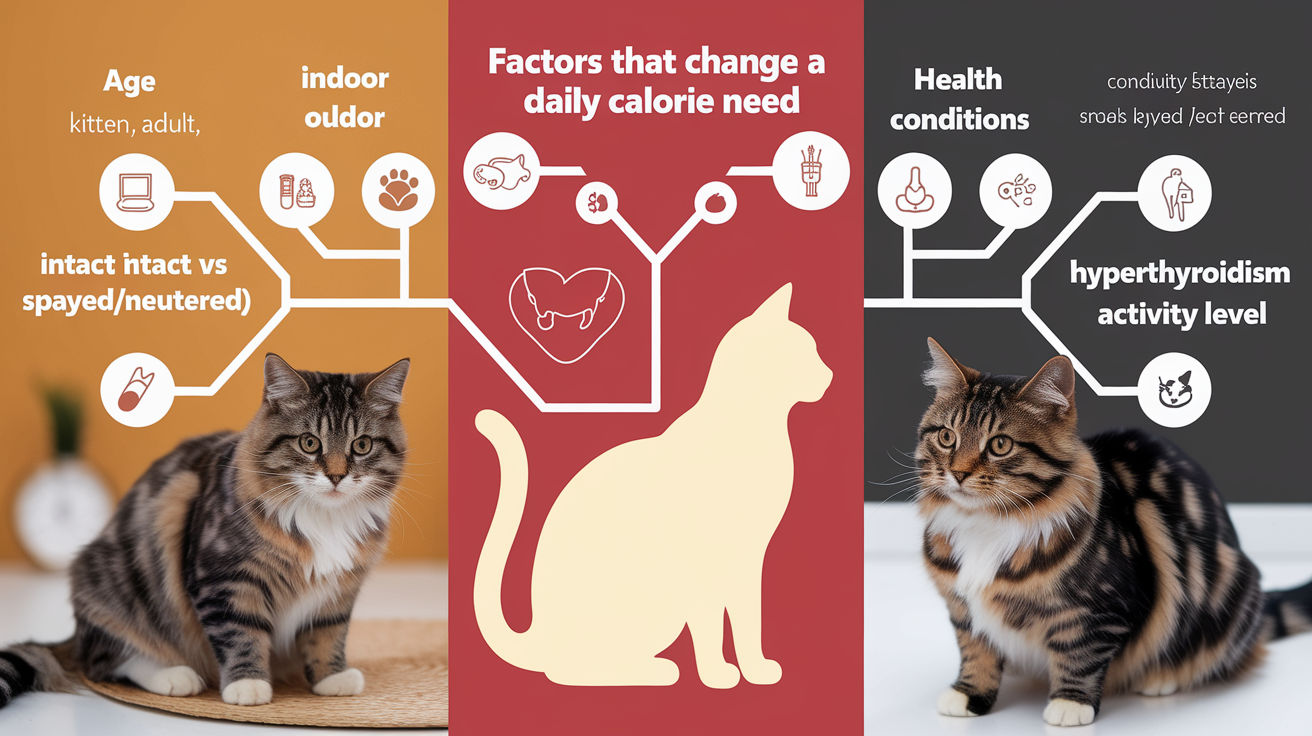
Age affects how much your cat should eat more than almost anything else. Kittens burn through calories building new muscle, bone, and tissue. Adult cats in their prime years (roughly one to seven years old) settle into steady maintenance needs. Senior cats between seven and ten typically need fewer calories because they slow down and nap more. But cats eleven and older often need more calories again. Not because they’re more active, but because their bodies struggle to pull nutrients from food as efficiently as they used to.
Indoor cats generally need fewer calories than outdoor cats. A cat who patrols the backyard, climbs trees, and chases bugs all afternoon burns more energy than one who naps on the couch between meals. If your indoor cat is pretty sedentary (sleeping most of the day and only getting up for food and the litter box) they probably sit at the lower end of the calorie range for their weight.
Reproductive status makes a noticeable difference. Intact cats have higher energy needs, usually around 1.4 times their RER. Once a cat is spayed or neutered, their metabolism drops, and they typically need only 1.2 times RER to maintain the same weight. This is why so many cats gain weight after being fixed if their portions aren’t adjusted.
Health conditions can push calorie needs up or down. A cat with hyperthyroidism might lose weight rapidly and need extra calories to keep up with their overactive metabolism. Diabetic cats need carefully controlled portions to manage blood sugar. Cats recovering from illness or surgery often need more calories temporarily to heal.
Key factors that shift daily calorie targets:
- Age (kitten, adult, senior, geriatric)
- Current weight and ideal weight
- Breed size (Maine Coons versus Siamese)
- Activity level (indoor versus outdoor, playful versus sedentary)
- Spay or neuter status
- Medical conditions (thyroid issues, diabetes, kidney disease)
Cat Calorie Needs for Kittens, Adults, Seniors, Pregnant & Nursing Cats
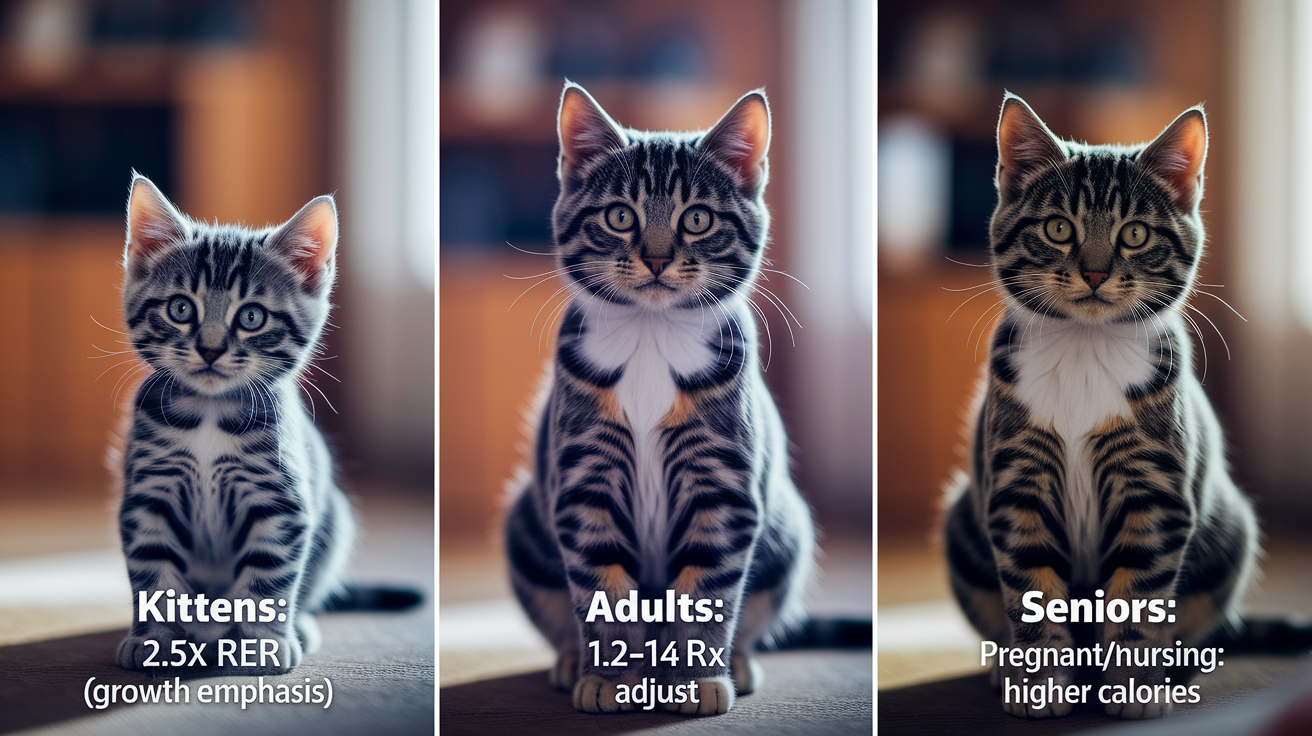
Kittens from birth to four months need about 2.5 times their resting energy requirement because they’re doing some of the fastest growing they’ll ever do. From four to twelve months, that multiplier drops to 2 times RER, but they’re still eating roughly double what an adult cat their size would need. Most kittens eat high fat wet food during this stage to help them pack on weight in a healthy way. You’ll need to adjust portions every few weeks as they grow, because a three month old kitten weighs a lot less than a ten month old.
Adult cats, classified as one year and older, usually fall into the 1.2 to 1.4 times RER range depending on whether they’re spayed or neutered. Most reach full adult size somewhere between nine and twelve months, and their calorie needs level off once growth stops. This is the stage where portion control becomes important, because it’s easy to overfeed a cat who’s no longer burning calories on growth.
Senior cats (generally considered ten or eleven years and older) often need fewer calories in the earlier senior years because they move less and sleep more. But around age eleven or older, some cats start losing weight even when eating the same amount, because their digestive systems aren’t absorbing fat and protein as well. Highly palatable wet food can help maintain weight in older cats who are getting pickier or struggling to keep weight on.
Pregnant or nursing cats need significantly more calories to support their own bodies plus the developing kittens. Underfeeding during pregnancy can lead to embryo loss, abnormal fetal development, spontaneous abortion, stillbirth, smaller litter sizes, or kittens who fail to thrive after birth. Nursing mothers can need almost twice their normal intake, especially if they’re feeding a large litter.
Portion Control and Feeding Examples Based on Cat Calories
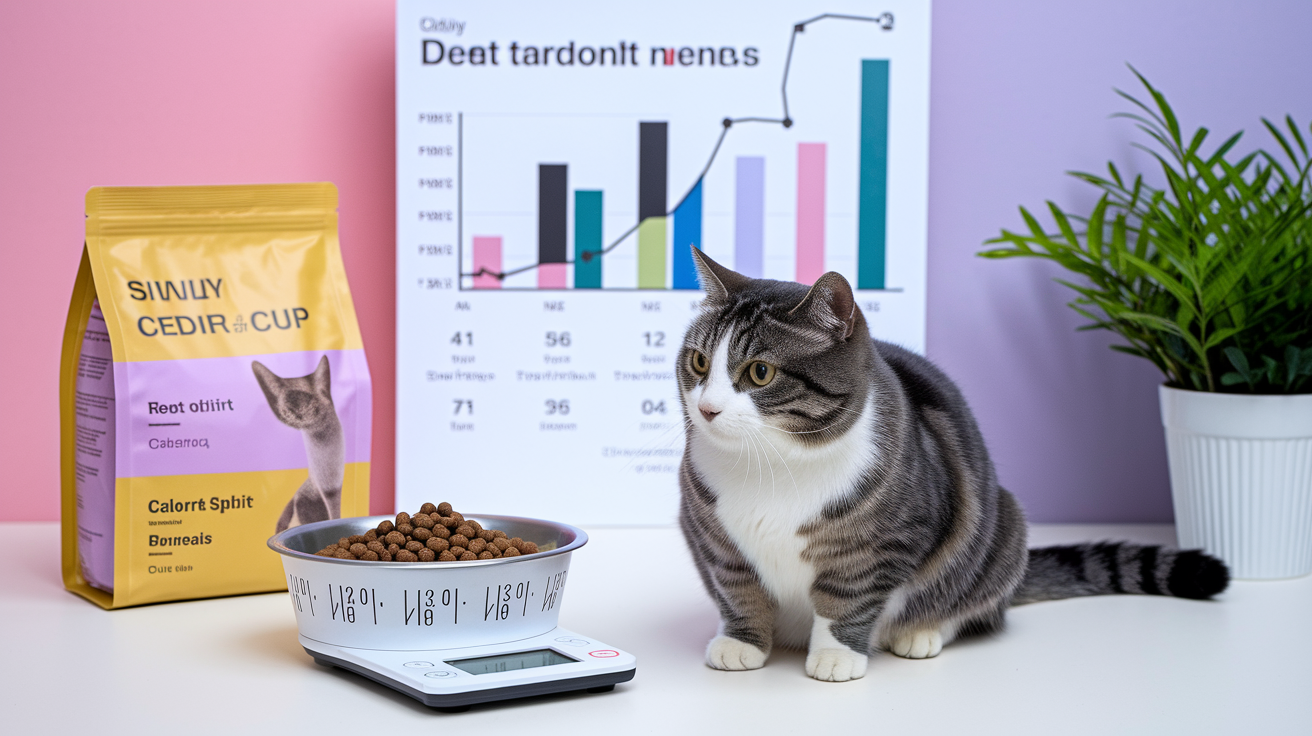
Once you know your cat’s daily calorie target, divide it into meals based on how often you feed. If your cat needs 200 calories per day and you feed twice daily, that’s 100 calories per meal. For a cat eating 250 calories daily on a three meal schedule, each meal would be roughly 83 calories. Measuring this out depends on checking the calorie content printed on your cat food bag or can. Most dry foods list calories per cup, while wet foods list calories per can or per 100 grams.
Wet food and dry food have very different calorie densities. A cup of dry kibble might contain 300 to 400 calories, while a 3 ounce can of wet food usually has around 70 to 100 calories. This means you can feed a much larger volume of wet food for the same calorie count, which is why wet food often feels more satisfying to cats and can help with weight management. If you’re mixing both, you’ll need to account for calories from each type.
Free feeding (leaving a bowl of dry food out all day) makes it nearly impossible to track calories and increases the risk of obesity. Cats don’t naturally self regulate well when food is always available, especially indoor cats with nothing else to do. Scheduled meals give you control over portions and let you notice changes in appetite, which can be an early sign of health issues.
Steps for portioning meals based on calories:
- Check the calorie content per cup or per can on your food label
- Compare that number to your cat’s daily target
- Divide the daily total into two or three meals
- Monitor your cat’s appetite, energy, and stool over a couple of weeks
- Adjust portions to account for treats, which count toward the daily total
Overfeeding and Underfeeding Risks in Cats
Somewhere between 30 and 35 percent of cats are overweight, according to VCA Animal Hospitals. Overfeeding leads to obesity, which raises the risk of diabetes, heart disease, arthritis, certain cancers, and a shorter life expectancy overall. Extra weight puts stress on joints, makes grooming harder, and can turn minor health problems into serious ones. Most owners don’t realize their cat is overweight until a vet points it out, because the weight creeps on gradually.
Underfeeding shows up faster and more obviously. You’ll see prominent ribs, a visible backbone, and a tucked in waist that looks too severe. Cats who don’t get enough calories can develop bone density problems, a compromised immune system, muscle weakness, dry and scaly skin, hair loss, failing eyesight, and in extreme cases, organ failure. Malnutrition also affects behavior. Underfed cats can become lethargic, anxious, or food obsessed.
It’s generally easier to increase calories and help an underweight cat reach a healthy weight than it is to reduce calories and get an overweight cat to lose pounds. Weight loss in cats has to happen slowly. Too fast and you risk hepatic lipidosis, a serious liver condition. That’s why preventing weight gain in the first place, through portion control and regular monitoring, saves a lot of stress down the road.
Weight Loss and Weight Gain Calorie Strategies for Cats
Body condition score (BCS) helps you figure out what your cat’s ideal weight should be. A healthy cat has ribs you can feel but not see, a visible waist when viewed from above, and a small abdominal tuck when viewed from the side. If your cat’s ribs are hard to feel under a layer of fat, or there’s no waist, they’re likely overweight. If ribs are sticking out and the waist is too pronounced, they’re underweight.
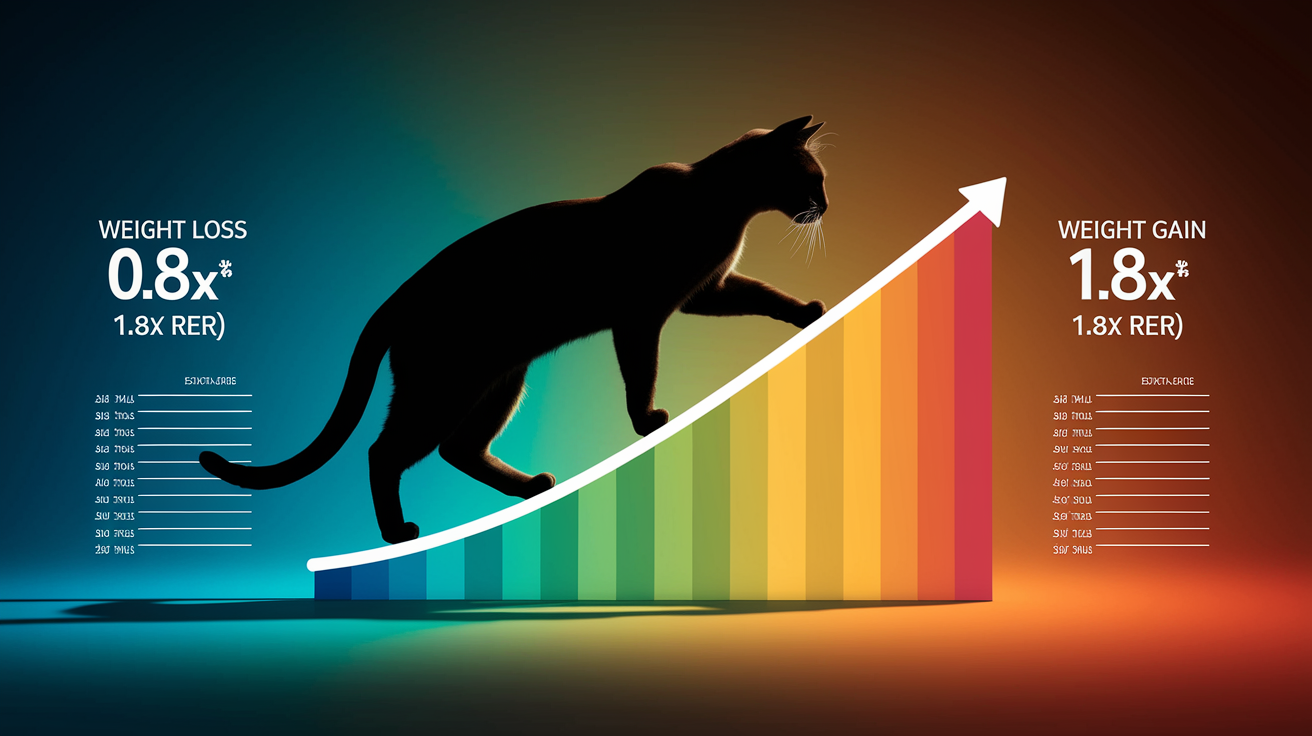
For weight loss, use 0.8 times the RER calculated for your cat’s ideal weight, not their current weight. So if your cat weighs 15 pounds but should weigh 10, calculate RER for a 10 pound cat and multiply by 0.8. This creates a controlled calorie deficit that allows gradual weight loss without triggering metabolic problems. Pair this with scheduled meals, no free feeding, and strict treat limits.
For weight gain, use 1.8 times the RER for your cat’s ideal weight. This higher multiplier supports muscle and tissue building without just packing on fat. High calorie, high protein wet food often works best here because it’s more palatable and easier to digest. Track weight weekly and adjust portions as your cat gets closer to their target.
| Goal | Formula | Notes |
|---|---|---|
| Weight Loss | 0.8 × RER (ideal weight) | Gradual deficit; stop free feeding |
| Weight Gain | 1.8 × RER (ideal weight) | Use high calorie wet food |
| Maintenance | 1.2–1.4 × RER | Adjust for spay/neuter status |
| Obesity Prone | 1.0 × RER | Strict portion control required |
How Treats, Snacks, and Food Quality Affect Daily Cat Calories
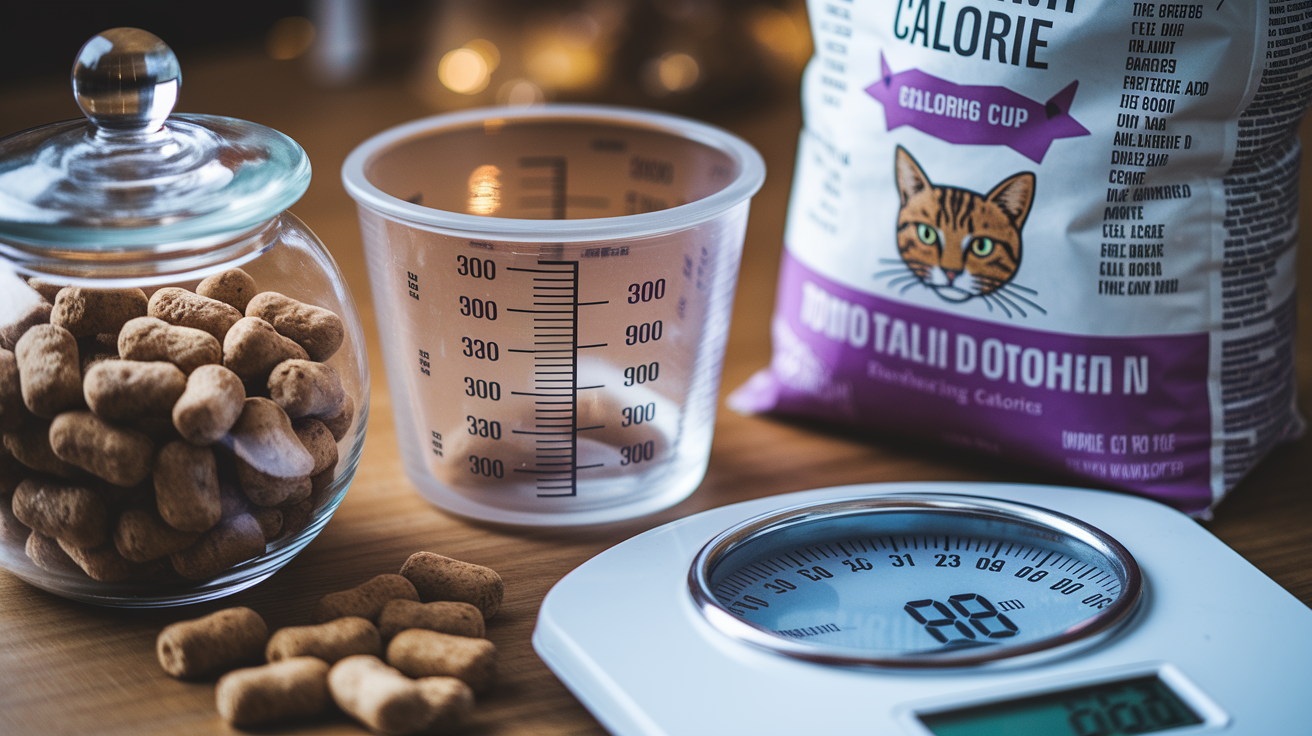
Treats count toward your cat’s total daily calories, not as extras on top. If your cat needs 200 calories per day and you give 40 calories in treats, you’re left with 160 calories for actual meals. Most commercial cat treats are calorie dense. Just a few small pieces can add up fast. Check the package for calorie information, and if it’s not listed, aim to keep treats under 10 percent of daily intake.
Cats are obligate carnivores, which means their bodies are designed to run primarily on protein and fat, not carbohydrates. The quality of those calories matters. A food with high quality animal protein (chicken, turkey, fish) and moderate fat will support muscle, coat, and energy better than a food loaded with fillers and plant based proteins. Cheaper foods often require larger portions to meet calorie needs because they’re less nutrient dense.
Human food is almost always a bad idea for cats. Their digestive systems don’t process many human foods well, and scraps add calories without balanced nutrition. A bite of cheese or a piece of deli meat might seem small, but it can represent a significant chunk of a small cat’s daily calorie budget.
Key points about treats, snacks, and food quality:
- Choose treats with clear calorie counts and adjust meal portions accordingly
- Look for high protein, low carb treats that fit a cat’s carnivore biology
- Avoid giving human food unless your vet has approved specific items for a health reason
- Measure treat calories just like meal calories to prevent accidental overfeeding
- Pick complete and balanced cat foods (meets basic nutrition needs on its own) rather than relying on variety through table scraps
When to Seek Veterinary Guidance for Cat Calorie Needs

Certain medical conditions make it impossible to safely manage calories on your own. Hyperthyroidism speeds up metabolism, so affected cats can lose weight rapidly even when eating more. Diabetes requires tight calorie and carbohydrate control to manage blood sugar. Kidney disease often demands a specialized low protein diet, which changes how you calculate calorie needs. Digestive disorders like inflammatory bowel disease can reduce nutrient absorption, meaning your cat needs more calories from highly digestible sources just to maintain weight.
If your cat is losing or gaining weight unexpectedly, not eating as much as usual, or showing signs of illness (vomiting, diarrhea, lethargy, increased thirst), check with your vet before adjusting portions. They can run bloodwork, assess body condition, and help you set a calorie target that fits your cat’s current health status. Ongoing monitoring matters, too. Senior cats, cats with chronic conditions, and cats on weight loss plans should have regular weigh ins and nutritional check ins to make sure the feeding plan is still working.
Final Words
Start with the simple rules: 20-33 kcal per pound for adult cats, WSAVA ranges by weight, and RER/MER formulas when you want a more precise number.
Adjust for kittens, seniors, activity level, and spay/neuter status. Count treats and human snacks toward the daily total, and watch stool and weight during a two-week check.
If you still wonder how many calories does a cat need per day, use these targets as a starting point and check with your vet. Small, steady changes make feeding easier and healthier.
FAQ
Q: Are 200 or 300 calories a day appropriate for my cat?
A: Whether 200 or 300 calories a day is appropriate depends on your cat’s weight, age, activity, and health. Aim for about 20–33 kcal per pound; 200 suits small cats, 300 suits larger or active cats.
Q: How many calories should a 12 lb cat eat?
A: A 12 lb cat should eat about 240–396 kcal per day (roughly 20–33 kcal per pound); adjust for age, activity, and neuter status, and check with your vet if unsure.
Q: Is 2 meals a day enough for a cat?
A: Two meals a day is usually enough for adult cats if those meals meet the daily calorie target; kittens need more frequent feedings—monitor weight, appetite, and stool and adjust as needed.